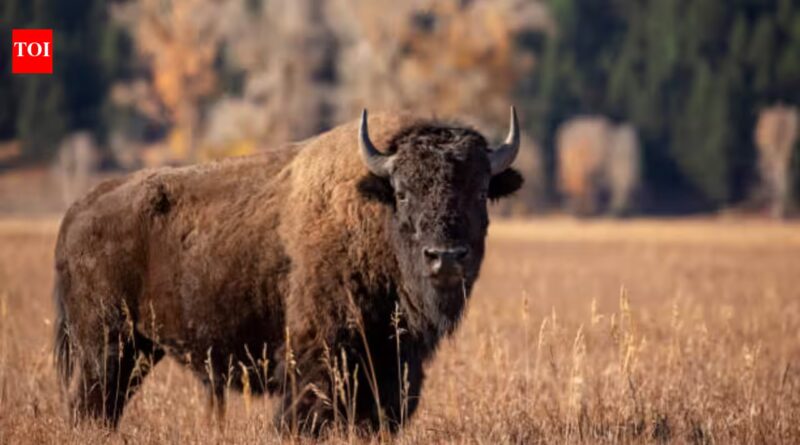
From tens of millions to just 1,000: 140 years after America’s national mammal vanished in the 1880s, indigenous tribes and conservationists are helping bring it back to the prairie
For America, bison have always been more than just an ordinary animal. The largest land mammal in North America, the massive, shaggy beast has been extremely important to the native cultures. Since 2016, it has also been crowned as America’s national mammal and is an apt representative of the country’s natural history.Bison, also referred to as “buffalo” have roamed the land for thousands of years and throughout, “they’ve been shaping us,” supporting ecosystems by grazing and migrating and influencing culture and history, said exhibition developer Siobhan Starrs. “They really are the American story, in a nutshell,” she says.Starrs is helming the bison-centric exhibitions hosted by Smithsonian’s National Museum of Natural History, that coincide with the celebration of America’s 250th this year. ‘Bison: Standing Strong’ began on May 7 and will run until May 2029. It charts the animal’s evolutionary history and relations with indigenous peoples, its rise and fall and its place in the future.Another exhibition, ‘Imagining Bison’ is showcasing a trove of materials-artefacts, documents and photographs- signifying the animal’s cultural importance. Running from May 21 to summer 2027, it will also offer details on the Smithsonian Institution’s efforts to conserve the bison in collaboration with Native American communities.“I learned from my Blackfeet grandparents that bison emerged from the supernatural underwater realm and were given to humans by the Divine to use as food and as material. In return, humans are to respect and revere the bison,” wrote Rosalyn LaPier in 2023, a historian at the University of Illinois at Urbana-Champaign and an enrolled member of the Blackfeet Tribe and Métis, explaining the importance of the animal in a video for the “Standing Strong” exhibition.
A lost native
According to a report by Smithsonian Magazine, tens of millions of bison lived in North America until the late 19th century, when hunters cut them down in huge numbers with the help of rifles. By the late 1880s, only around 1,000 of the mammals survived.Not just hunting, western expansion and industrialisation also contributed to the bison’s demise. The federally backed removal of bison by settlers purposely deprived Native Americans of a food source and culturally significant animal. Bison meat fed workers building the Transcontinental Railroad, and its hides were coveted by American and European manufacturers of clothing and industrial belts. The completion of the railroad brought even more hunters to the region.The bison’s slaughter is eerily illustrated in the “Standing Strong” exhibition by an 1892 photograph of a man standing atop a mountain of skulls waiting to be processed at Michigan Carbon Works.
Restoring the national mammal
Now, US is home to some 500,000 bison, most in commercial herds. Some are under management by conservationists and tribes, while others rove within the boundaries of national parks such as Yellowstone and Theodore Roosevelt. Their reintroduction stands as one of the greatest examples of conservation success, symbolising both ecological revival and honouring of Native American heritage.Surviving the last Ice Age, bison have been on this planet for over 2.6 million years. Global symbols of strength, they can weigh up to 907 kilograms (2,000 lb) and have a body length of 3.7 meters (12 ft). Moving up to speeds of 56 kilometres per hour (35 mph), American bison cover long distances to graze. They have specialised stomachs, which give them the ability to ferment vegetation prior to digestion. It is with this movement and diet that they help the prairie flourish. As they forage, their weight and constant eating prune the grasslands. Droughts are also common in this region, and the bison wallows create pools of water that many animals use as their primary drinking source. Even in death, bison alter the ecosystem. Their carcasses are rich with digested seeds that eventually burst into patches of wildflowers and grasses, which feed essential pollinators like birds and bees.During the mass hunting campaign against them, a small herd of buffalo escaped the slaughter and found refuge in the newly established Yellowstone National Park. This small remnant of two dozen individuals marked the starting point for a monumental conservation journey. A coalition of biologists and environmental activists set about recovering the American bison with the Yellowstone herd. Through dedicated breeding programs, their population grew to almost 5,000. This effort expanded, further rewilding buffalo in the plains, and has been so successful that their impact on the landscape can be seen from space.The conservation organisation American Prairie, in partnership with Earthjustice, a non-profit environmental law group, aims to see thousands of bison once again roaming free. By purchasing private ranching land in Montana, their mission is to create a three-million-acre nature reserve. Similar programs are being established across the United States, in places such as South Dakota and Colorado. Additionally, over 60 tribes are actively involved in reintroducing buffalo to their lands.Ervin Carlson, president of the Intertribal Buffalo Council, manages an 800-animal herd for the Blackfeet Nation in Montana. The council, which operates in 22 states and across close to 90 tribes, was formed in the 1990s to help bring bison back to Indigenous lands. Many of the animals come from national park herds. Those animals help inject genetic diversity into tribal herds, said Carlson, which is crucial to the species’ survival.New research, funded by One Earth and led by RESOLVE and the UN Environment Programme World Conservation Monitoring Centre, revealed that reintroducing large mammal assemblages has shown significant potential for ecosystem restoration. The study identifies that rewilding just 20 large mammal species, including the American bison, can restore over 8.5 million square kilometres of land globally. Restoring these beasts is not just revitalising the Great Plains but also rebolstering the connection to the natural world and honouring the cultural heritage of indigenous people.