Scientists discover a 17-million-year-old ape fossil in Egypt that could rewrite early ape evolution | World News
[
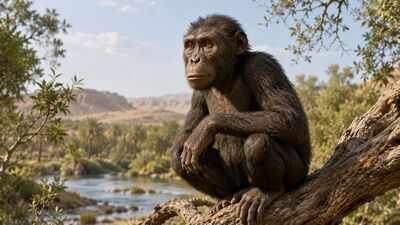
For decades, discussions about the earliest stages of ape evolution have largely centred on East Africa. Many of the fossils that shaped scientific thinking were discovered there, leading to the view that the region was the primary setting where the ancestors of modern apes first diversified before spreading elsewhere. That picture has now become less straightforward. A newly described fossil ape from northern Egypt is prompting researchers to reconsider where some of the earliest branches of the ape family tree emerged. Rather than replacing earlier discoveries, the find expands the map, suggesting that parts of northeastern Africa may have played a much larger role in hominoid evolution than previously recognised.
New Masripithecus fossil from Egypt fills a gap in early ape evolution
The newly identified species has been named Masripithecus, a previously unknown genus of ape that lived roughly 17 to 18 million years ago during the Early Miocene. It was identified from fossilised lower jaw remains uncovered in northern Egypt.While East African fossil sites have produced numerous early ape discoveries over several decades, comparable deposits in North Africa have mostly yielded fossils of Old World monkeys. That imbalance has left an important geographical gap in understanding how early hominoids evolved. According to the research published in Science, titled “An Early Miocene ape from the biogeographic crossroads of African and Eurasian Hominoidea”, the authors argue that Masripithecus fills part of that missing evolutionary and geographical record.
How Masripithecus fits into the early ape family tree
The significance of the discovery extends beyond identifying a new fossil species. The researchers combined anatomical evidence from the fossil with molecular and morphological evolutionary modelling to examine where the animal fits within the ape family tree.Their analysis indicates that Masripithecus appears to be more closely related to the lineage leading towards modern apes than several similarly aged ape fossils previously found in East Africa.According to the study, a combined molecular-morphological Bayesian tip-dating analysis positions Masripithecus closer to crown hominoids than coeval fossil apes from East Africa. That placement suggests the evolutionary split leading towards living apes may already have been underway in northeastern Afro-Arabia before later dispersal into Eurasia.The researchers therefore propose that “crown Hominoidea might have originated during the Early Miocene in the underexplored northeastern part of Afro-Arabia, rather than in eastern Africa or Eurasia.”
Why Northern Egypt is important for early ape fossil discoveries
The discovery also highlights how scientific understanding can be influenced by where fossils have been searched for most intensively. East Africa has understandably dominated discussions because of its exceptionally rich fossil record. Yet other regions have received far less attention for historical, logistical and geological reasons.This uneven pattern of exploration may itself have shaped long-standing assumptions. In the journal’s summary, they note that a focus on one African region may have shaped our ideas about where hominoids first emerged. Northern Egypt occupies a strategic position between Africa and Eurasia, making it an important location for investigating how ancient mammals dispersed between continents. Discoveries from this region could therefore help explain evolutionary movements that cannot be fully reconstructed from East African fossils alone.
How the New Egypt fossil expands our understanding of early ape evolution
The new fossil does not overturn decades of research into human origins, nor does it establish Egypt as the definitive birthplace of modern apes. Instead, it widens the conversation by introducing evidence from a region that has remained comparatively underexplored.As per the study, early ape evolution was probably more geographically complex than previously recognised, with different populations occupying various parts of Afro-Arabia millions of years before later evolutionary branches eventually gave rise to today’s gibbons, orangutans, gorillas, chimpanzees and humans.As additional fossil discoveries emerge from North Africa, scientists may gain a clearer understanding of how these early ape lineages were connected. For now, Masripithecus provides an important reminder that the history of human ancestry is still incomplete, and that some of its missing chapters may lie outside the regions that have traditionally dominated the fossil record.