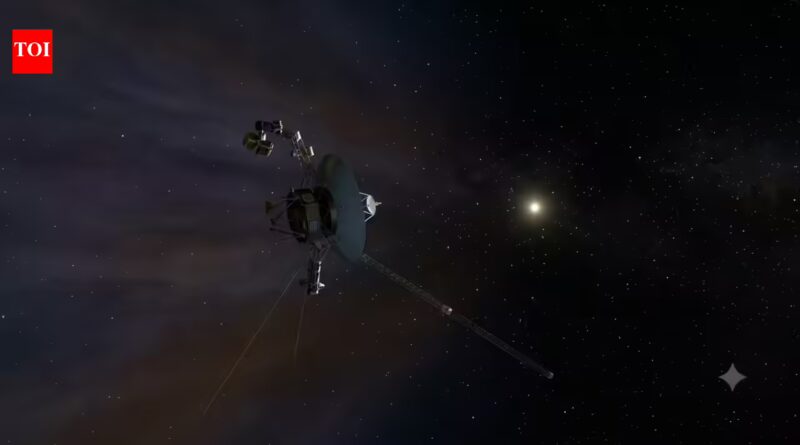
NASA’s Voyager 1 left Earth in 1977; now its signal takes over 22 hours to reach us and it is still sending data
[
When NASA launched Voyager 1 in September 1977, it was expected to explore the outer planets before continuing its journey into deep space. Nearly 49 years later, the spacecraft is still continues to send information back to Earth from about 25 billion kilometres away, making it the most distant human-made object ever built.The distance is difficult to imagine. Voyager 1 is now more than 170 times farther from the Sun than Earth is. Even light, which travels at around 300,000 kilometres every second, takes more than 22 hours to cover that distance.That also means talking to Voyager 1 is anything but quick. A command sent from Earth takes more than 22 hours to reach the spacecraft. Once Voyager 1 responds, the reply takes another 22 hours or more to get back. It means every exchange with the spacecraft takes almost two days.Because of the delay, NASA’s engineers cannot control the spacecraft in real time. They send commands, wait patiently, and only find out nearly two days later whether everything worked as planned.
Where no spacecraft reached before
In 2012, Voyager 1 made history by crossing the heliopause, the point where the Sun’s influence ends and the space between stars begins and became the first spacecraft to enter interstellar space.Although it is far beyond our solar system’s outer boundary, Voyager 1 has not stopped working. Two of its scientific instruments are still collecting information about the environment around the spacecraft. That data travels across billions of kilometres before reaching giant antennas on Earth, where scientists receive and study it.The signal is incredibly weak by the time it arrives. Even so, NASA is still able to detect it after its journey through space.
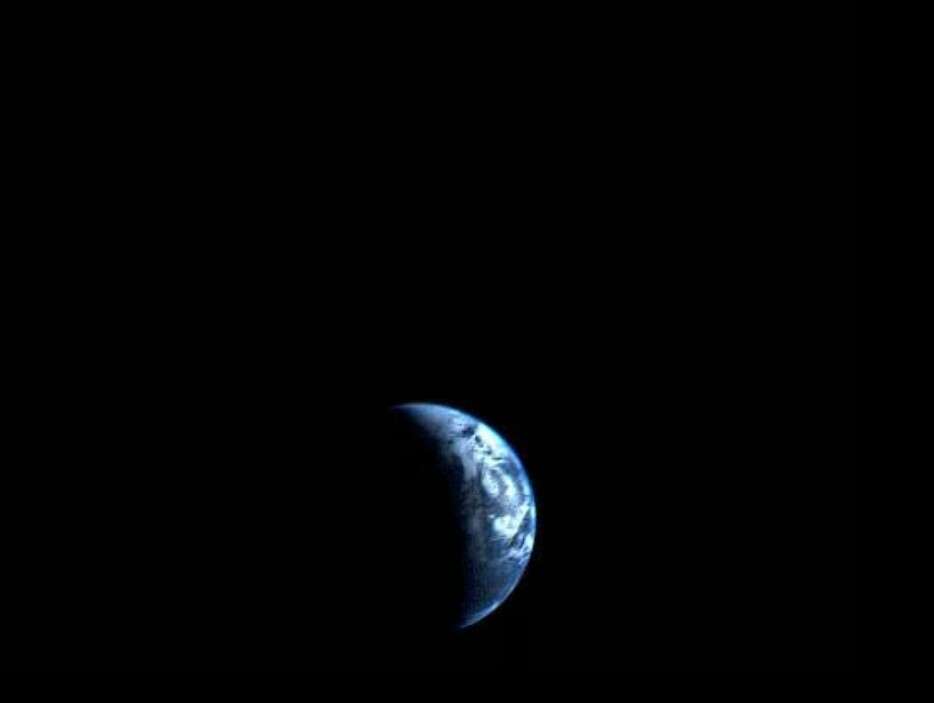
Earth’s picture taken by Voyager 1
What keeps Voyager going
One reason Voyager 1 has survived for so long is that it does not depend on sunlight for power. At such a great distance from the Sun, solar panels would not be useful anymore. Therefore, the spacecraft carries generators which have been powered by plutonium. The heat produced by them is converted into electricity, which Voyager 1 uses to keep operating even in the darkness of deep space.When Voyager 1 was launched, its power system produced about 470 watts of electricity. Today, that has fallen to around 230 watts. The amount of available power drops a little every year as the plutonium slowly decays.That may not sound like much electricity, but it has been enough to keep the spacecraft alive and sending messages across 25 billion kilometres.
NASA is making every watt count
The biggest challenge facing Voyager 1 today is not its distance from Earth but its shrinking power supply. To make electricity last as long as possible, NASA has been gradually switching off systems which are no longer needed. Over the years, scientists have powered off heaters and some scientific instruments so the spacecraft can continue sending data.In 2026, another detector was switched off to save power. NASA believes Voyager 1 may continue sending at least basic engineering data into the 2030s if the remaining power is managed carefully. However, as the years pass, more instruments will have to be turned off one by one.Voyager 1 is expected to reach another historic milestone around November 2026. By then, it will be about one light-day away from Earth. That means even a signal travelling at the speed of light will take a full 24 hours to reach the spacecraft.