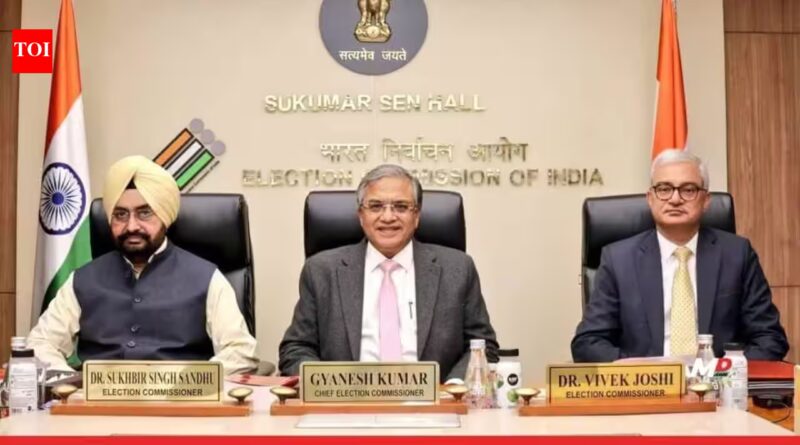
Election Commission Of India: SIR queries raised, but pertained to draft stage; focusing on some notes while ignoring others gives only one part of picture: EC | India News
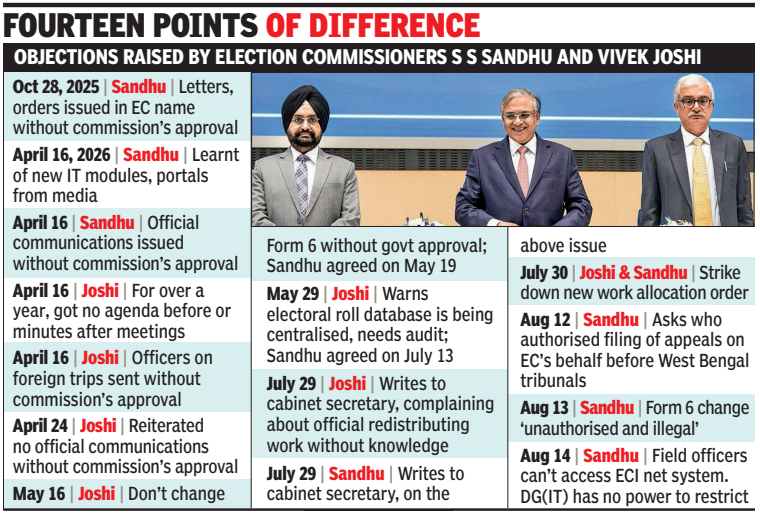
NEW DELHI: Faced with criticism for election commissioners S S Sandhu and Vivek Joshi being cut out of crucial decisions, the Election Commission on Wednesday said the “operational queries, inputs and suggestions” raised over the past 10 months by the two commissioners, including on the special intensive revision (SIR) process, remained limited to the draft stages and were part of the standard administrative practice and decision-making process at the Commission.All decisions taken by the commission in the past one year, including SIR, “are an outcome of the unanimous decisions of the full commission,” EC asserted in a statement rebutting the contention that the chief election commissioner (CEC) Gyanesh Kumar was acting unilaterally.EC was reacting to a report in Indian Express claiming that the two election commissioners had objected to steps taken by the poll panel on 14 occasions over 10 months, including the changes made to Form 6 as part of SIR, restricting field officers’ access to electoral roll databases and even regarding postings and foreign tours involving EC personnel.
Focusing on some notes while ignoring others gives only one part of picture: EC
Sandhu and Joshi even wrote to the Cabinet secretary separately on July 29, complaining about redistribution of work by the senior deputy election commissioner (DEC) in charge of administration EC and the resultant centralisation of decision -making , said the report.In its statement, EC said that differing views and observations are a normal part of deliberation in any institution before a final decision is taken. “Written notes, observations, technical suggestions and internal checks and balances are standard, ongoing practices to ensure transparency, legal compliance and operational rigour.” EC said all its actions as well as official orders, decisions and administrative decisions have been in accordance with laws and commission’s instructions and carry full legal sanction.
_
“Highlighting certain specific internal notes/observations spread over the period of 10 months while overlooking the much larger body of approvals, decisions, instructions and initiatives give only one part of the picture,” EC said adding that its decisions, instructions, 40 new initiatives and conduct of polls in six states/UTs in the past one year were all based on unanimous decisions by the commission in the past one year.Sources in EC said the objections were largely raised in written notes sent by the election commissioners to the deputy election commissioners (DECs), in many cases after they had signed on the concerned file following a unanimous decision; including in the cases of changes made to Form 6. The two commissioners, Joshi in May and Sandhu in August, had argued that changes in Form 6 could be carried out only by the government. However, sources maintained, after they along with the CEC unanimously approved the file relating to SIR orders for Bihar (Phase 1) and then a dozen states (Phase 2), which listed the revised Form 6 and the accompanying declaration on citizenship. In fact, by the time Sandhu objected, the Supreme Court had already upheld the validity of SIR as well as the processes followed by EC, sources said.As part of his case against powers getting centralised and CEC not taking his two colleagues in confidence, Sandhu had raised the issue of who had authorised filing of appeals on EC’s behalf before the SIR tribunals in West Bengal. Sources, however, told TOI that this was as per the Supreme Court order dated April 1, 2026, particularly para 9 that stated that appeals may be filed by “persons whose names have been excluded from the voters list” or “by the authorities of the ECI, who may be aggrieved by the inclusion of names by the adjudicatory authorities”.On the commissioners’ alleged objection to centralisation of the electoral roll database or ERONet/ECINet, allegedly with restricted access to field officers like the electoral registration officers (EROs) to decide on addition of deletion of names, the Commission said digital platforms such as ECINet operate under strict data security protocols to prevent unauthorised tampering, manipulation, etc. “IT security checks and audit controls are standard cybersecurity measures implemented across national databases. Statutory authorities, including EROs and district election officers (DEOs), function as per statutory powers for registration and deletion under law,” said EC. Sources in EC told TOI that while EROs and DEOs may have faced access issues due to system errors on some occasions, they have full access to electors databases and have been deciding on roll updations during SIR.Sources in the Commission did not contest Joshi’s claim that agenda and minutes of EC meetings were not being circulated, but said this has been the norm before the present commission assumed office.Responding to the objections to decision of the DEC (Administration) to change the officer in charge of IT division, sources said that powers to decide appointment, recruitment, transfers and postings of officers above the level of section officer and posting and transfer of personal staff of election commissioners and DECs were delegated to DEC (Administration) in 1997.
Share your thoughts in the comments
Be respectful · TOI community guidelines
Regarding Joshi’s April 16 objection to EC officers being sent on foreign trips without the “commission’s” approval, sources said the power in this regard has been with the CEC since long.Reacting to Sandhu’s objection that he had learnt of EC’s new IT modules, portals etc from the media, sources pointed that both Sandhu and Joshi were present at ECINet’s launch on January 22.